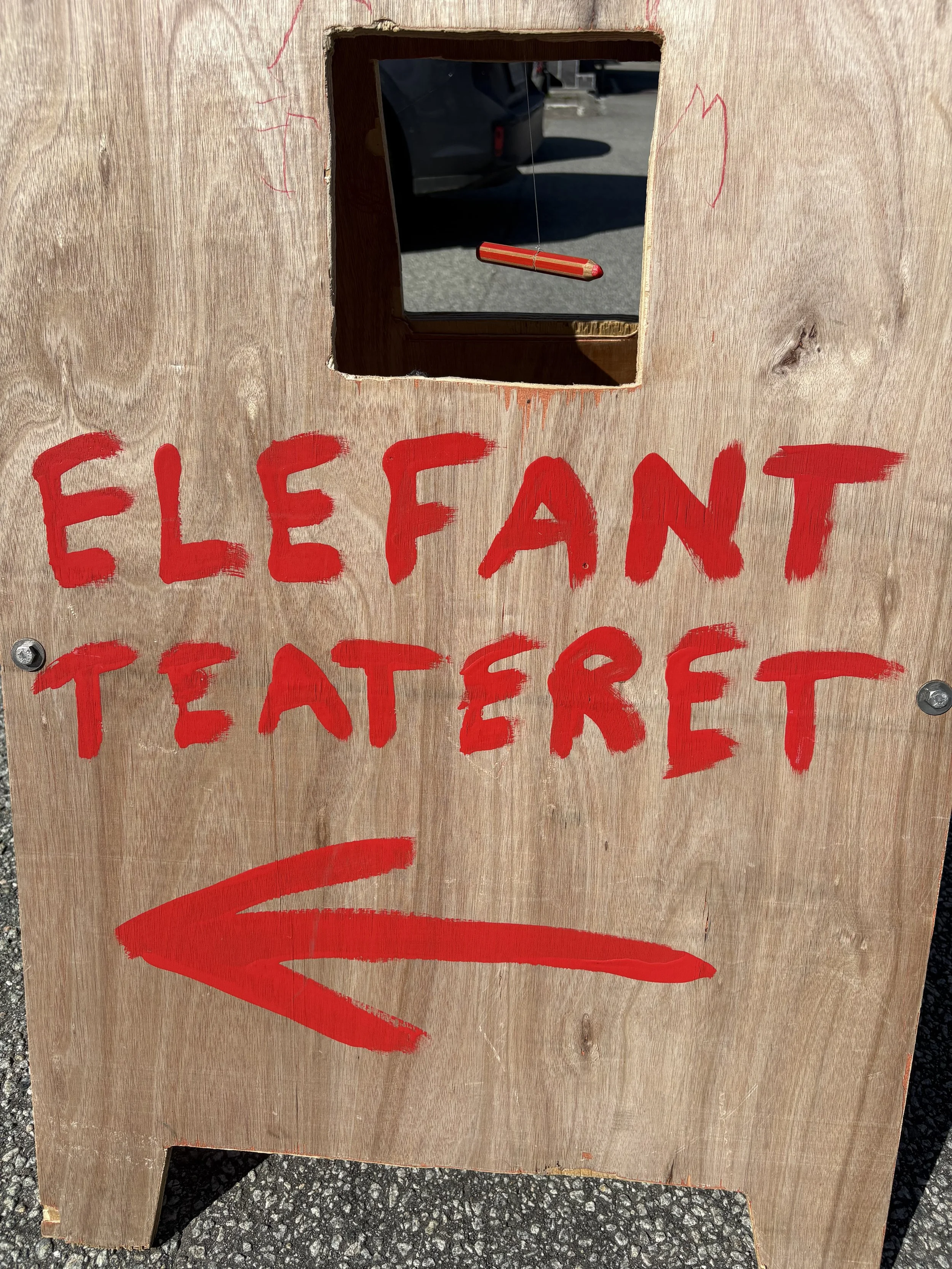
I’ve just come to the end of two weeks at Elefantteateret in Stavanger, Norway — my second year returning to this beautiful venue (It feels like a boutique hotel inside!) to facilitate dance sessions for early years communities and nursery groups. Thirty groups. Nearly 600 children. Three classes a day, ten days. And I left feeling genuinely inspired, challenged, and full of questions I want to keep exploring.
A Mini Forest in a Tin
This year’s focus was sound and listening — and I brought with me a small prop that ended up sparking some of the richest moments of the residency: a miniature forest, made inside a tin.
I made this prop, as a way to draw children’s attention to something small but inspire their memory of being in a forest. Forest is a place where allows me to slow down and listen.
I’d hold it up and ask: ‘What sounds can you hear in a forest?‘
The answers were wonderful. Most children reached straight for animals — wolves, bears, owls, squirrels, birds, frogs. Some talked about the sound of trees, or the sound of a tree falling. A few went somewhere darker and more poetic: shadows, witches, scary things that live between the branches. I loved that. That’s exactly the kind of imagination I’m trying to make space for.
The tin was red, which turned out to matter. Before I revealed what was inside, I’d ask: ‘What do you think is in here?‘ And the responses shifted noticeably depending on the group. Some children — particularly those from more homogenous Norwegian cultural backgrounds — tended to guess sweets, cookies, gingerbread, chocolate. Others, from more diverse cultural backgrounds, brought entirely different associations such as money, dragon, presents. Small moments like these remind me how much culture, lived experience, and environment shape the way children perceive and imagine the world — and how a dance session can become an unexpected window into that.
The Slide Whistle
The second part of the session used a slide whistle to create live sound for the children to respond to physically. A slide whistle has this quality I love — it moves up and down on a continuous, smooth scale, so there’s no sharp jump, just a gradual glide. I demonstrated how the body might follow that sound: rising, sinking, stretching, curling, wiggling. Then I handed the listening over to them, and asked them to move in response to whatever I played.
It was captivating. Every time. Even in the more hesitant groups, something would shift once the whistle started.
Thirty Groups, Thirty Worlds
Working across thirty groups over two weeks gave me a genuinely rare opportunity to observe. Each group brought its own energy, culture, and rhythm — and I found myself adapting constantly.
Some groups were immediately expressive, loud, and fiery. Ready to move, ready to share, full of autonomous energy. With those groups, my task often became about creating moments of stillness and listening — demonstrating, gently but clearly, that quiet has its own power. Slowing down. Waiting. Letting the pause do the work.
Other groups — often those with more unified Norwegian cultural backgrounds — were initially quieter and more reserved. They needed encouragement to unlock. But once they were switched on, they were extraordinary players. Their attention was full and precise. Once they committed, they committed wholeheartedly.
Neither is better. Both are inspirational. But working across such a spectrum in a short time made me sharper as a facilitator, and more attentive to what each group actually needs — rather than what I assume they need.
The Ones Who Started in the Corner
One of the moments I keep returning to: in several sessions, there were children who chose, at the start, to sit in the corner of the room. Watching. Not joining. Often with a teacher on their side.
By the end of every single session, they had joined in.
I don’t take that lightly. It says something about what dance — and particularly dance for early years — can do when it’s given the right containment. It doesn’t demand. It invites. And it waits. And eventually, for almost every child, the invitation lands.
That feels important. Dance is for everyone. Not everyone enters at the same moment and with the same motivation, through the same door. But the door is always open.
Why It Matters — Starting at early age
Being with children this young — 2-5 years old — and watching them grow within a single 45-minute session, I’m reminded again of why this work matters so much at this particular stage of development.
Nursery and early years settings are where children begin to learn how to be with others. Communication. Social cues. Navigating space alongside different bodies, different temperaments, different ways of seeing. Dance facilitates so many of these things — non-verbal expression, imagination, embodiment, a sense of togetherness — in a way that feels natural and joyful rather than instructional.
It doesn’t feel like learning. But it is. Profoundly.
Elefantteateret, and these nearly 600 children have given me a lot to think about. I’m already looking forward to next year.
Takeshi Matsumoto is a London-based dance artist, choreographer, and dance movement psychotherapist. He is Co Director of Ichi Ni San (https://ichinisan.co.uk), a dance company creating work for Early Years audiences.